Pull your production storage folder and database to your local environment
digifactory/laravel-pull-production-data is a Laravel package for pull your production storage folder and database to your local environment.
It currently has 12 GitHub stars and 17.683 downloads on Packagist (latest version v5.0.2).
Install it with composer require digifactory/laravel-pull-production-data.
Discover more Laravel packages by digifactory
or browse all Laravel packages to compare alternatives.
Last updated





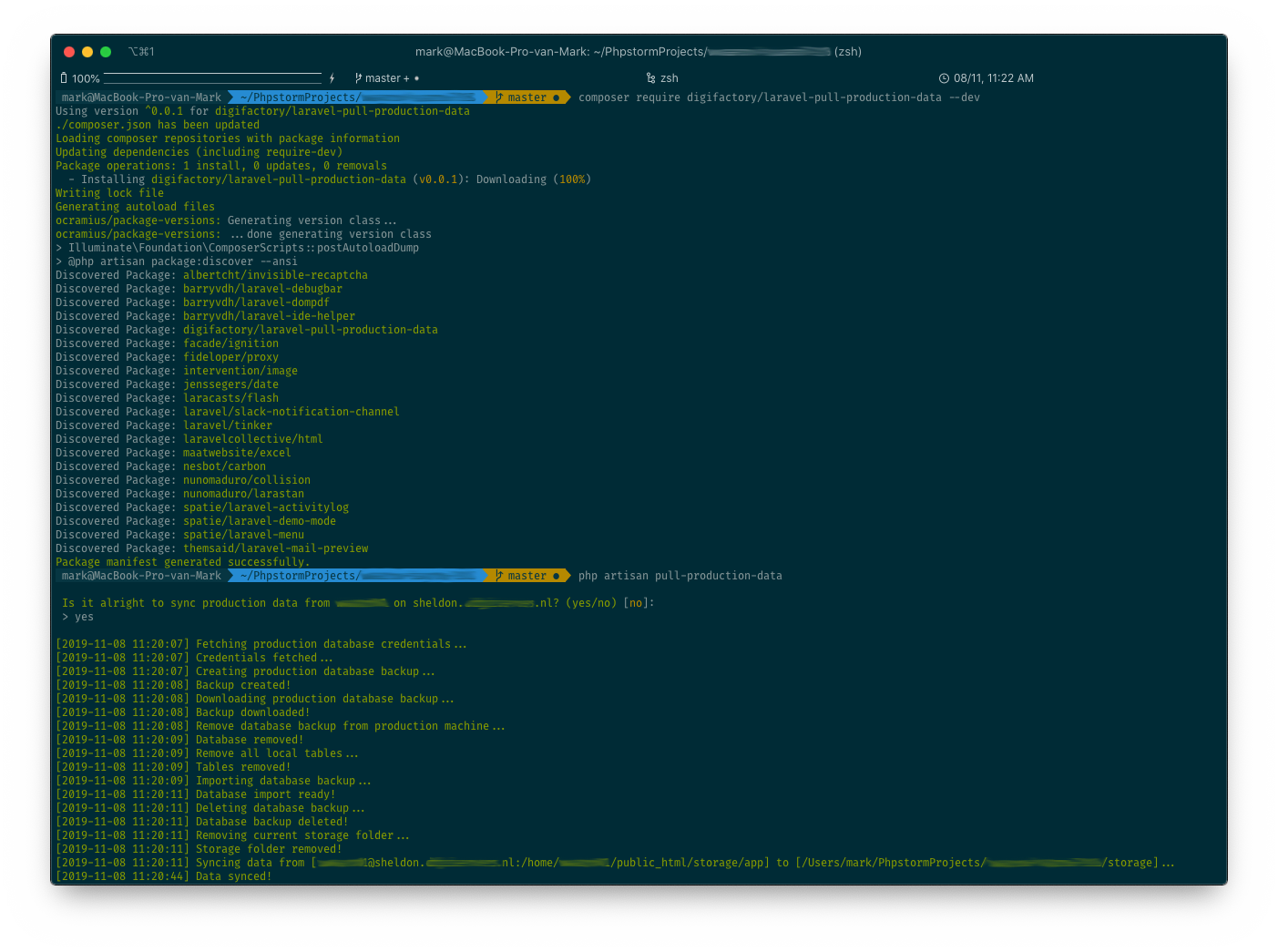
This package provides a command to download your production database and storage/app folder to your local environment.
In the current state this package mainly scratches our own itch. Nonetheless this package can be used in nearly every Laravel environment.
The package assumes you have:
DEPLOY_SERVER and DEPLOY_PATH (customisable in the config)mysql binary available on your local machinemysqldump binary available on your production machineYou can install the package via composer:
composer require digifactory/laravel-pull-production-data --dev
You can publish the config file:
php artisan vendor:publish --provider="DigiFactory\PullProductionData\PullProductionDataServiceProvider" --tag="config"
By default both the database and the storage folder will be synced.
php artisan pull-production-data
The following flags are available:
| Flag | Description | |-----------------------------|-------------------------------------------------| | -D, --no-database | Whether the database should not be synced | | -S, --no-storage-folder | Whether the storage folder should not be synced | | -C, --no-appending-commands | Whether the appending commands should run |
Since this version it is possible to run any command when php artisan pull-production-data is completed. For example: this way you can anonimize data for local/testing purpose.
composer test
Please see CHANGELOG for more information what has changed recently.
Please see CONTRIBUTING for details.
If you discover any security related issues, please email [email protected] instead of using the issue tracker.
The MIT License (MIT). Please see License File for more information.