Send any Filament table as an .xlsx on a schedule: save the filters, search, sort and columns once, pick a time and recipients, and the report arrives on time, exactly once, as the owner, with the data scope you re-apply for the worker.
asignua/filament-scheduled-reports is a Laravel package for send any filament table as an .xlsx on a schedule: save the filters, search, sort and columns once, pick a time and recipients, and the report arrives on time, exactly once, as the owner, with the data scope you re-apply for the worker..
It currently has 0 GitHub stars and 4 downloads on Packagist (latest version v1.1.0).
Install it with composer require asignua/filament-scheduled-reports.
Discover more Laravel packages by asignua
or browse all Laravel packages to compare alternatives.
Last updated





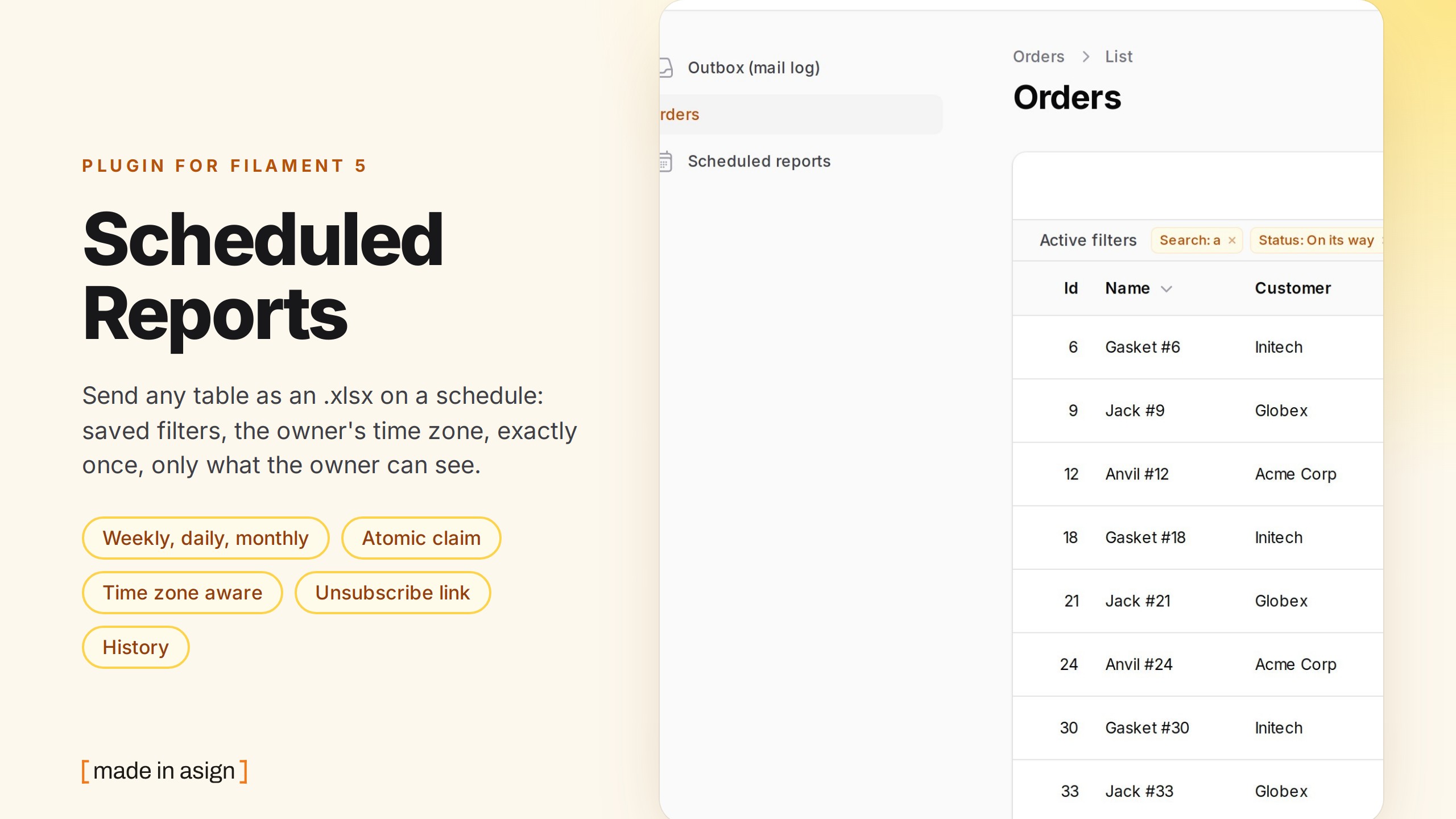
Read this first: the worker does not run your panel's middleware. A report is built in a queue worker, as the report's owner, with no browser request behind it. The panel's middleware, the
ServingFilamentevent and a second panel'sbootUsing()do not run there. Anything that narrows what a person sees in the browser through those (a tenant-like global scope, a «current branch» setting, a value in the session) is missing in the worker, and the mail would carry every row to every recipient. Models' own global scopes, policies and the page'sgetEloquentQuery()do apply; the rest is yours to re-apply withScheduledReportsPlugin::make()->beforeRun(fn (Authenticatable $owner, Panel $panel, ScheduledReport $report) => …), derived from$owner(a worker serves many jobs, so never from a value left by the previous run). Add->requireScopeHook()and the plugin refuses to schedule, and pauses stored reports, on a panel without that hook. See Data scope in the worker.
Every Monday you open a table, set the same filters, press «Export» and forward the file. This plugin does it for you: «send this table every Monday at 9:00». It is the scheduling companion of filament-xlsx-export and reuses its export, so the file is the one the Export button would have produced.
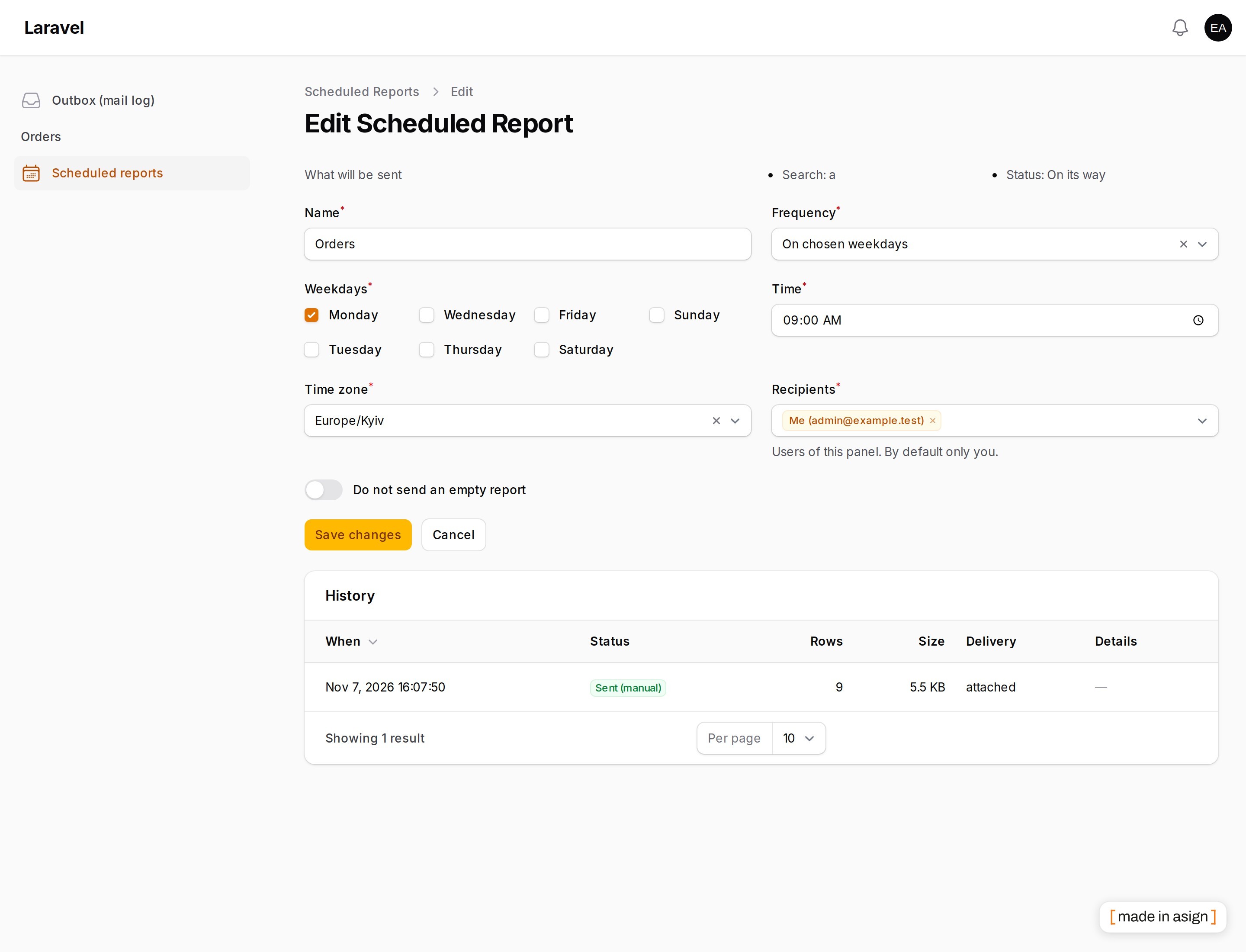
next_run_at is stored in UTC. A time that does not exist when the clocks go forward becomes the first valid minute; a time that happens twice runs once, at the first occurrence.UPDATE … WHERE next_run_at = <what I read>; overlapping cron ticks and several workers cannot send a report twice. After downtime there is one catch-up run, not a series.canAccessPanel, the scheduleReport gate, the page being on the panel and open to the owner, and the export action being visible, enabled and authorized are all checked again at every run (and every download). If the owner is gone or lost access, the report pauses and no file is made. What the owner's data scope hides outside the models' own scopes and policies is yours to re-apply: see the note above.List-Unsubscribe one-click header).manageScheduledReports), history of runs, pause / resume, run now, duplicate, delete. The filters are shown as text so you can see what will be sent.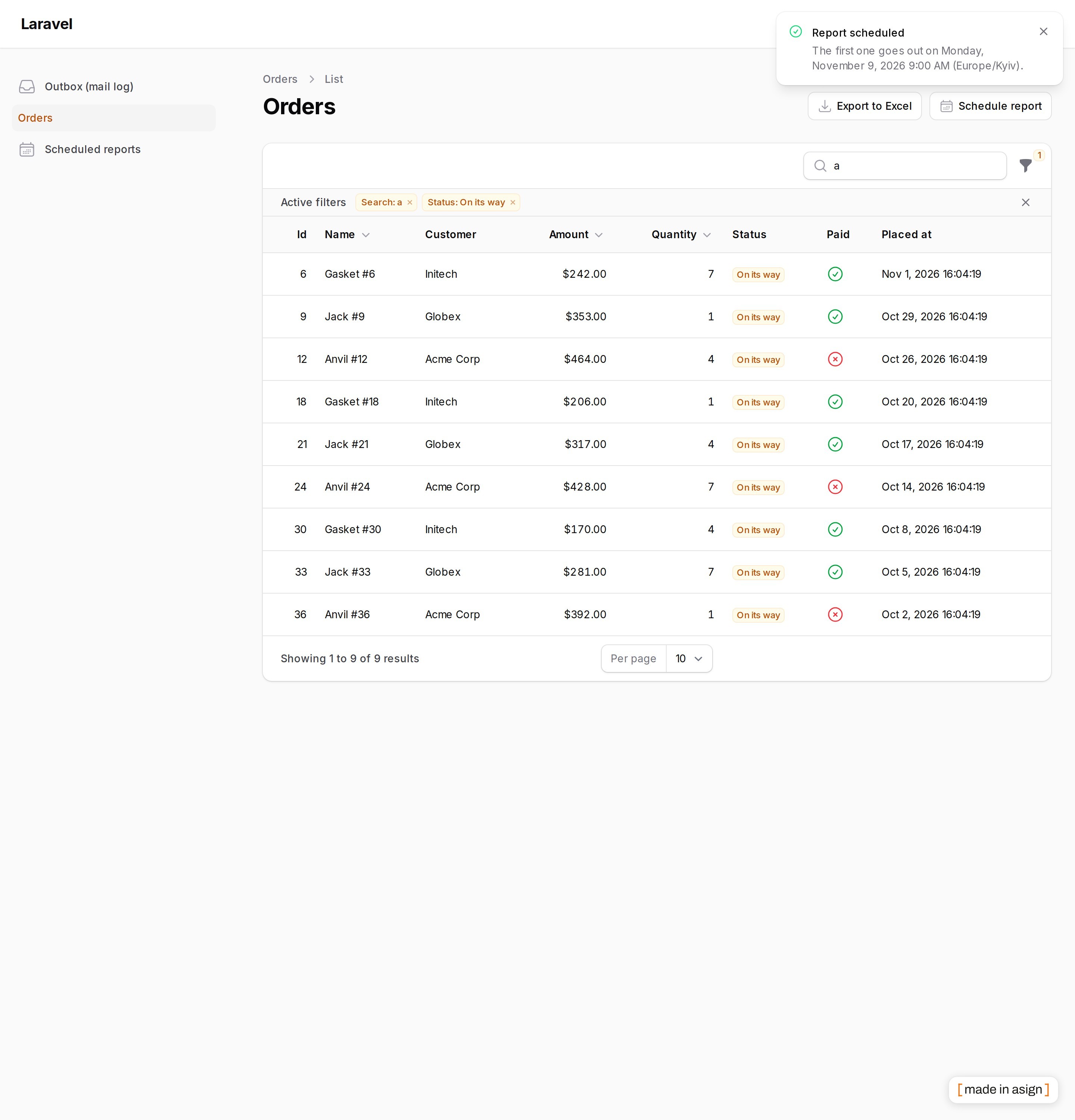
PHP 8.3+, Laravel 12 or 13, Filament 5, asignua/filament-xlsx-export ^1.2 (installed with it), a working queue worker and the Laravel scheduler (php artisan schedule:run every minute), and a mail transport. Without a queue worker mail and runs are not sent: the queue is where they go.
composer require asignua/filament-scheduled-reports
php artisan migrate
The migration is loaded from the package. Register the plugin on every panel that should offer it:
use Asignua\FilamentScheduledReports\ScheduledReportsPlugin;

$panel->plugin(
    ScheduledReportsPlugin::make()
        // Whom the owner may add besides themselves: id => label. Default: nobody, only the owner.
        ->recipients(fn (User $owner): array => $owner->team->users()->pluck('name', 'id')->all())
);
Add the button next to the export on any table page (ListRecords or your own Page with a table):
use Asignua\FilamentScheduledReports\Actions\ScheduleReportAction;

protected function getHeaderActions(): array
{
    return [XlsxExportAction::make(), ScheduleReportAction::make()];
}
The action finds the export action by name (xlsxExport; ->exportAction('name') for another) and inherits its column picker and options.
Gate::define('scheduleReport', fn (User $user, ?string $page = null) => $user->can('reports.schedule')); // $page: the page class
Gate::define('manageScheduledReports', fn (User $user) => $user->isAdmin());                              // see and pause everybody's
Without scheduleReport there is no button, the resource is closed and stored reports do not run. A false answer later pauses the report as owner_lost_access.
use Filament\Panel;
use Illuminate\Contracts\Auth\Authenticatable;

ScheduledReportsPlugin::make()
    ->beforeRun(function (Authenticatable $owner, Panel $panel, ScheduledReport $report): void {
        // Re-apply here what your panel middleware / bootUsing() sets for a browser request, from $owner.
        app(CurrentBranch::class)->set($owner->branch_id);
    })
    ->requireScopeHook() // optional: no hook, no button, no run
The hook runs after the owner is signed in and before the page is built. If it throws, the run fails (and, after three failures, pauses) and no file is made.
max_reports_per_owner (20), max_recipients (25) and max_concurrent_per_owner (the export's queue.max_per_user) cap what one owner can pile up; a due report of an owner at the concurrency limit waits for the next minute, «Run now» is refused. A pause by a manager (manageScheduledReports) is binding: the owner cannot run, resume or duplicate that report, and a run that was already queued sends nothing. Report files and download links live file_retention_hours (7 days), and every download checks the scheduleReport gate and the page again.
ScheduledReportsPlugin::make()
    ->allowExternalRecipients()
    ->allowedDomains(['example.com']); // exact match; a subdomain is another domain; no domains = nobody
The form says it plainly: every recipient gets the data the owner can see, whatever their own access.
scheduled-reports:run (registered every minute; schedule.enabled in the config) claims due reports and queues a job. The job acts as the owner, builds the page component from stored plain data (page class, filters, search, sort, columns, export options) with no HTTP request and no Livewire snapshot, asks the table for its own query and writes the file with the export's code. The file is attached up to max_attachment_mb (10); a bigger one goes as a link that needs a sign-in as the owner, and only the owner gets it.
Pauses: owner_lost_access (inactive, deleted, no panel, gate or page access), target_gone (panel, page, action, a used filter or tab, or every saved column is gone), tenancy_unsupported, failed, no_recipients, manual. A removed column is dropped with a warning in the history.
app.url (or ->urlRoot('https://…')); the request's Host is trusted only when it is one of the panel's configured domains.php artisan vendor:publish --tag=filament-scheduled-reports-config — table names, schedule, attachment size, queue and connection, failure limit, history retention (history_days, pruned daily by scheduled-reports:prune), the «Run now» interval. Translations: --tag=filament-scheduled-reports-translations.
vendor/bin/phpunit. The race tests need real databases: bash tests/Databases/run.sh starts throwaway MariaDB 11.4 and PostgreSQL 16 containers and removes them. The workbench: bash workbench/serve.sh (seeded users in the script).
See CHANGELOG.md.
.xlsx downloads of what is on the screen.xlsx, .ods and .csv into any modelAll plugins: https://filamentphp.com/plugins?q=asign
Catalogue of free and commercial plugins: https://asign.tech/en/plugins
The MIT License (MIT). See LICENSE.md.
Get paid by clients abroad
Wise gives you local bank details in several currencies and converts at the mid-market rate. Useful when your invoices are not in your own currency.
Try WiseNew Laravel packages worth a look, once a month. No spam, one-click unsubscribe.


